The Hardest Rep You’ll Ever Do Is the One That Gets You Off the Couch
I know you’re reading this because you’ve been thinking about it for a while.
Not casually. Not in a “maybe someday” way. In the way that sits in the back of your mind at night when the house is quiet. The way that shows up when you catch your reflection and don’t recognize the woman looking back. The way that whispers every time you get winded going up a flight of stairs or struggle to get off the floor after playing with your grandkids.
You want to start. You just don’t know how. Or you’re afraid it’s too late. Or you tried before and it didn’t stick. Or you’re embarrassed because you used to be active and now you can barely walk around the block without your knees aching.
I hear you. And I need you to know something before we go any further:
You are not too old. You are not too out of shape. You are not too far gone. And the woman who starts today, no matter where she’s starting from, is braver than the woman who waits for the perfect moment that never comes.
Why Nobody Talks About This Honestly
The fitness industry has a problem. Too much of it is marketed to people who already look fit.
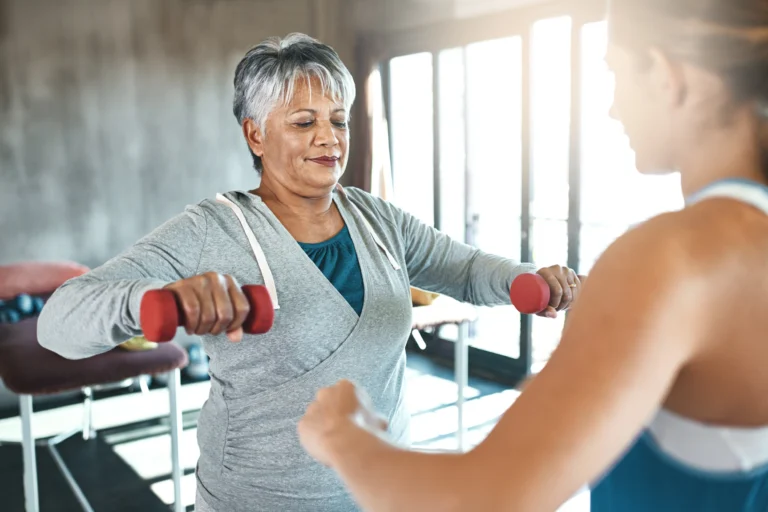
Starting over is most of what I do. For women in their 60s and beyond that is my senior fitness training: strength, balance and mobility, progressed from wherever you are today. Locally I work from the studios in Newport Beach and Irvine or come to your home anywhere in Orange County.
Scroll through any gym’s Instagram and you’ll see toned bodies, heavy lifts, intense workouts, and transformation photos that make you feel like you’re already behind before you’ve taken a single step. The message, whether they intend it or not, is clear: this space is for people who already belong here.
No wonder you’re intimidated.
But here’s what those posts don’t show you: every single one of those people started somewhere. Many of them started exactly where you are right now. Uncertain. Uncomfortable. Wondering if their body could still do this.
It can. And the research is encouraging.
The National Institute on Aging reports that strength training can help older adults increase muscle strength and support mobility and independence. Federal physical activity guidance also emphasizes that if you haven’t been active in a while, starting slowly is appropriate. Even small amounts of movement count, and you can build from there.
And age doesn’t eliminate your ability to get stronger. A systematic review and meta-analysis of randomized controlled trials found that adults 75 and older were able to significantly increase both muscle strength and muscle size through resistance training.
If the body can still adapt in your 70s and beyond, you are not too late at 40, 50, or 60.
You are not too late.
What Starting Over Actually Looks Like
I want to strip away every image you have of what “getting back in shape” looks like and replace it with the truth. Because the truth is a lot less intimidating than the fantasy, and it’s a lot more effective.
Week one is not about fitness. It’s about showing up.
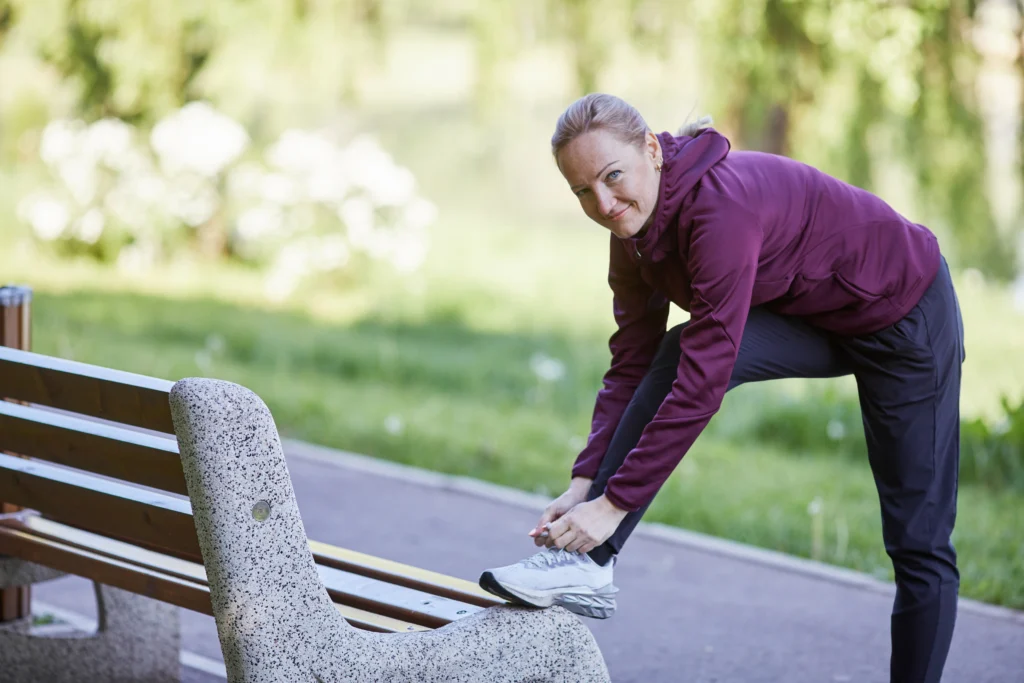
You don’t need to join a gym. You don’t need new workout clothes. You don’t need a plan that covers the next twelve weeks. For many women, a simple starting goal can be 15 to 20 minutes of movement, three days this week. That’s it.
Walk around your neighborhood. Do ten bodyweight squats using your kitchen chair for support. Practice standing on one foot near a countertop or sturdy chair for support as you start rebuilding your balance. Stretch for ten minutes in your living room while watching TV.
None of that looks like a fitness magazine. All of it counts. All of it matters. And all of it is building the habit that everything else grows from.
Weeks two through four: add structure, gently
Start incorporating some basic resistance movements. Wall push-ups. Chair-assisted squats. Step-ups on your bottom stair. Resistance band rows using a properly secured door anchor or other stable attachment point. You don’t need heavy weights yet. You need your muscles to remember what it feels like to work.
Build to 25 to 30 minutes, three to four days per week. Alternate between strength days and walking days. Rest when your body tells you to rest, not when a calendar says you can.
Month two: find your rhythm.
By now, something may be shifting. You may not dread movement the way you did at the beginning. You might even look forward to it. Your body is starting to adapt. Maybe your energy feels a little more consistent. Maybe certain everyday movements feel easier. And perhaps the biggest change is that showing up is starting to feel less like a decision and more like something you do.
This is when most women make the mistake of doing too much too fast. Don’t. The momentum you’re building right now is more valuable than any dramatic acceleration. Stay the course. Add a little weight. Walk a little farther. Trust the process.
Month three and beyond: this is where it gets exciting.
Your body is changing. Not just how it looks, but how it feels. Stairs are easier. Getting off the floor is easier. Carrying groceries is easier. The confidence that comes from feeling capable in your own body starts showing up in ways that have nothing to do with the gym.
You can also choose to work with a personal trainer from the beginning. In fact, if you’re unsure where to start, worried about injury, dealing with pain or limitations, or simply want accountability and guidance, professional support can make those first weeks feel far less overwhelming. A good trainer will meet you at your current level and build from there. You do not need to get in shape before hiring a trainer.
The Fears That Keep You Stuck (And Why They Don’t Have to Stop You)
I’ve had versions of this conversation hundreds of times. These fears are real, and they deserve to be taken seriously. But they don’t have to decide what happens next.
“I’m too out of shape to start.” That’s like saying you’re too sick to go to the doctor. The whole point of starting is that you’re not where you want to be. If you were already fit, you wouldn’t need to start. Your current condition is not a disqualification. It’s the reason.
“I’ll hurt myself.” This fear deserves respect, because it means you’re thinking about your body’s limitations. The answer isn’t to avoid exercise. It’s to start at the right level with the right guidance. Chair exercises, walking, and gentle resistance work can all be appropriate starting points depending on your abilities. Inactivity carries risks too. The National Institute on Aging notes that about 30% of adults over 70 have trouble walking, getting out of a chair, or climbing stairs, and that maintaining and building strength can help support mobility and independence as we age.
“People will judge me.” Most people in the gym are far more focused on their own workout than yours. But here’s the deeper truth: you don’t need anyone else’s approval to start taking care of yourself. Walking into a gym for the first time at 55 when you feel completely out of place takes courage. Starting when it’s hard is one of the bravest versions of fitness there is.
“I’ve tried before and failed.” An attempt that didn’t stick doesn’t mean you failed. Maybe the program wasn’t designed for you. Maybe the expectations didn’t match your life. Maybe you needed more support than you had. This time, start smaller, expect less in the short term, and build a wellness team that actually supports you.
“It’s too late to make a difference.” Research shows that adults in their 70s, 80s, and even 90s build meaningful strength from resistance training. If it’s not too late for them, it is absolutely not too late for you.
What You Need to Let Go Of
Starting over means letting go of some things that are weighing you down more than any barbell ever could.
Let go of what you used to be able to do. Let go of using the body you used to have as the standard for what you should be able to do now. The body you had at 25 or 35 belonged to a different season of your life. She served you well. Thank her. But you don’t have to keep competing with her. You’re building something new, and it can be just as powerful in a completely different way.
Let go of the idea that it has to be intense to count. A 20-minute walk counts. Ten squats counts. Five minutes of stretching counts. The all-or-nothing mindset can keep you stuck. The “something is always better than nothing” mindset is what will get you moving and keep you moving.
Let go of the scale as your measure of progress. Your first measures of progress should be: did I show up? Do I feel a little better? Can I do something today that I couldn’t do last week? Those are the metrics that matter when you’re starting over. The scale can wait. A long time.
Let go of doing this alone. You don’t have to figure this out by yourself. There are professionals, like me, whose entire career is built around meeting women exactly where they are and helping them build from there. Whether that’s in a gym or in your living room, you deserve guidance that fits your life
Why Starting Now Matters More Than Starting Right
I could give you the perfect program. The perfect schedule. The perfect meal plan. And if you spent the next three weeks perfecting your plan instead of actually moving, you’d be further behind than the woman who just went for a walk.
Perfection is procrastination wearing a productivity mask.
Start messy. Start small. Start scared. Just start.
Because every day you wait is a day your muscles get a little quieter. And every day you move is a day they remember how to speak. I’ve written about what happens when you build muscle after 40 and 50, and the research is encouraging: your body still has the capacity to adapt and get stronger. It just needs you to give it a reason.
This Is Your Invitation
I’ve trained women in their 30s who were starting for the first time. Women in their 50s who hadn’t exercised since their kids were born. Women in their 60s who were recovering from surgery. And women in their 70s who decided they weren’t done yet.
Every single one of them was afraid at the beginning. Every single one of them wondered if they could do it. And every single one of them discovered that their body was far more capable than they believed.
You may surprise yourself too.
You don’t need to be ready. You don’t need to be in shape. You don’t need to have a plan. You just need to decide that you matter enough to try.
That decision is the first rep. And it’s the hardest one you’ll ever do.
Everything after that has something to build on.
Starting over after 40, 50 or 60?
Whether it is senior fitness training for strength and balance or menopause & perimenopause training for the midlife shift, the first step is the same: a free 15-minute consultation call. If we’re a good fit, the next step is a full assessment, in studio in Newport Beach or Irvine, in your home, or online.
Frequently Asked Questions
What’s the best exercise for someone who hasn’t worked out in years?
Walking and basic movements like supported chair squats, wall push-ups, and balance exercises can be great places to begin. Start slowly and choose movements that match your current abilities. If you have pain, balance concerns, injuries, or a medical condition, you may need modifications or professional guidance. The best exercise is one you can do safely and consistently.
How long does it take to see results when you’re starting from scratch after 40?
There isn’t one timeline that applies to every woman. Early progress may show up as better consistency, improved confidence, easier everyday movement, or gradually increasing strength before you see major physical changes in the mirror. Your results will depend on your starting point, training, nutrition, recovery, health, and consistency. Focus first on what your body can do that it couldn’t do before. The visible changes can follow.
An Affirmation for You:
I am not starting over. I am starting from experience. Every step forward is proof that my body still has something to give. I choose to begin. Not tomorrow. Not Monday. Now.
If you’re ready to take the first step and want someone in your corner who will meet you exactly where you are, you can explore my personal training and coaching services or reach out to connect with me here.
Love Yourself,
Jennifer 💖