This Isn’t About Getting Fit. It’s About Staying Free.
I want to tell you about what matters to the older women I work with.
They don’t care about a thigh gap. They don’t care about macros. They don’t care about how many calories they burned.
They care about getting out of a chair without grabbing the armrest. They care about walking to the mailbox and trusting their legs to carry them there and back. They care about picking up a grandchild without being afraid they’ll drop him. They care about showering without worrying that today is the day they slip.
They care about staying in their own homes. On their own terms. For as long as they can.
That’s what fitness looks like after 65. And if you think that sounds small, you’ve never watched someone lose it.
The Conversation Nobody Has Soon Enough
Here’s what I’ve noticed: we talk about fitness as if it only matters when you’re young enough to look good in a swimsuit. The entire industry is built around before-and-after photos, transformation challenges, and body goals that expire the moment you stop chasing them.
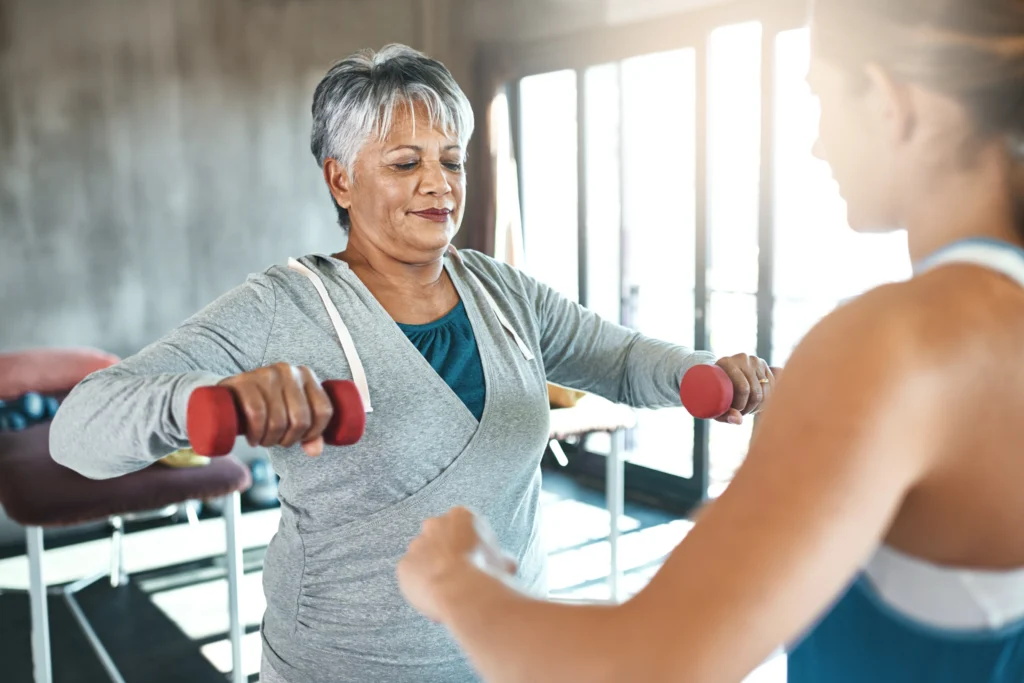
This is what my senior fitness training looks like in practice: strength, balance and mobility work progressed carefully from wherever you are today, in studio in Newport Beach or Irvine, or in your home — including Laguna Woods and the surrounding communities.
But the most important season of your fitness journey isn’t your 30s or 40s. It’s your 70s. Your 80s. The decades where the question isn’t “how do I look?” but “can I still do this by myself?”
According to the CDC, more than one out of four adults over 65 falls each year. In 2021, falls caused over 38,000 deaths among older adults and resulted in nearly 3 million emergency department visits. They are the leading cause of injury death for older adults in the United States.
And here’s the part that breaks my heart: falling once doubles your chances of falling again. And many people who fall, even if they’re not injured, become so afraid of falling that they stop moving altogether. They stop going for walks. They stop leaving the house. They stop living.
That fear steals more years than the fall itself.
But falls don’t have to be inevitable. Strength can be built at any age. Balance can be improved at any age. And the woman who starts training at 65, or 70, or 77, is not too late. She’s exactly on time.
What I See That Most Trainers Miss
Most personal trainers don’t work with women over 65. Not because they don’t care, but because they weren’t trained for it. The certification programs focus on young, healthy clients with straightforward goals. They don’t teach you how to train a woman with osteoporosis, arthritic knees, a fear of falling, or a hip replacement.
I’ve learned more from working with my older clients than from any textbook I’ve ever read. Because training a 77-year-old woman in her living room requires you to throw out the playbook and actually listen.
Listen to what her body can do today, not what it could do twenty years ago. Listen to what scares her. Listen to what she’s lost. Listen to what she’s desperate to hold onto.
That listening is the foundation of everything I do with her. And it’s what’s missing from most of the fitness industry’s conversation about aging.
What Training After 65 Actually Looks Like
It doesn’t look like Instagram. It doesn’t look like a CrossFit box. It doesn’t look like anything you’ve been told fitness is supposed to look like.
It looks like this:
Chair squats. Standing up from a chair and sitting back down, slowly and with control. This single movement pattern is one of the most important functional exercises for older adults because it mimics what you need to do dozens of times a day: get up from a toilet, a couch, a dining chair, a car seat. We start with the chair there for safety, and over time, we reduce how much she relies on it.
Standing balance holds. Holding onto a countertop or the back of a chair and lifting one foot off the ground for 10 to 30 seconds. This trains the stabilizer muscles in your ankles, knees, and hips that prevent falls. It’s simple. It’s unglamorous. And it could save her life.
Wall push-ups and countertop push-ups. Upper body strength matters for more than aesthetics. It’s how you catch yourself when you stumble. It’s how you push yourself up from the floor if you fall. It’s how you carry a bag of groceries or lift a window open. We start at the wall and progress to the countertop as she gets stronger.
Heel-to-toe walks. Walking in a straight line, placing one foot directly in front of the other, like walking a tightrope. This challenges your dynamic balance and mimics the kind of balance adjustments your body needs to make on uneven surfaces, curbs, stairs, and wet floors.
Gentle resistance band work. Bands provide variable resistance without heavy load, which is ideal for joints that can’t tolerate dumbbells yet. They can be used for rows, presses, lateral walks, and rotational movements that strengthen the muscles protecting the spine and hips. Not every client starts here, but it’s a tool I introduce when the body is ready for it.
Stretching and mobility. PNF assisted stretching is one of the tools I use with my older clients. It improves range of motion, reduces stiffness, and makes everyday movements like reaching overhead or turning to look behind you feel possible again.
None of this is complicated. All of it is life-changing.
The Research Is Clear: Strength Matters for Healthy Aging
A landmark 2026 study published in JAMA Network Open followed 5,472 women between the ages of 63 and 99. Women with greater muscular strength had significantly lower mortality risk, even after researchers accounted for physical activity, sedentary time, walking speed, and other health factors. Women in the highest grip-strength group had about one-third lower mortality risk than women in the lowest group.
And the finding that stopped me: muscle strength was associated with lower mortality even among women who didn’t meet the recommended 150 minutes of weekly aerobic exercise.
A 2025 systematic review published in Life found that balance- and strength-based exercise interventions can reduce falls in community-dwelling older adults. The review also found improvements in balance, mobility, and strength across several types of exercise interventions.
These aren’t studies about elite athletes. They’re studies about women like my client. Women who want to stay in their homes, take care of themselves, and live with dignity. The science says the most powerful tool they have is strength.
What You Gain When You Start (At Any Age)
I want to tell you what I notice every time I start working with an older client, because the changes start before the physical ones do.
They show up. That might sound simple, but for a woman in her 70s who could have easily decided she was too old to try, showing up is an act of courage. She chose to invest in herself at an age when most people have stopped believing their body can still change. That decision alone tells me everything I need to know about who she is.
They learn to trust the process. We start slow. Build a foundation. Get the body reacquainted with movements it hasn’t done in a while. There’s nervousness, and that’s completely normal. But each session, I watch them settle in a little more. The willingness is there, and willingness is where every transformation begins.
I learn as much from them as they do from me. Working with women in their 70s and beyond has shifted how I think about what fitness means. It’s not about performance. It’s not about aesthetics. It’s about preserving the ability to live your life without asking permission from your body. That perspective has made me a better trainer for every client I work with, regardless of age.
A Note to the Daughters
If you’re reading this and you’re in your 40s or 50s, I need you to hear two things.
First: everything you do now is building the woman you’ll be at 70. Every squat, every walk, every serving of protein, every hour of sleep is a deposit into a future where you can still build muscle, still move independently, still carry your own life. Don’t wait until your body forces you to start. Start now, while you have the luxury of building ahead of the need.
Second: if you have a mother, an aunt, a grandmother, or an older woman in your life who has stopped moving, who has become afraid, who has quietly accepted that her body is something she can no longer trust, please know that it doesn’t have to be that way.
She can start. Today. In her living room. With a chair and someone who believes in her.
I’ve seen what happens when a woman in her 70s picks up her first resistance band and does something she didn’t think her body could still do. The look on her face isn’t just surprise. It’s hope. And hope is the most powerful thing I’ve ever watched enter a room.
You Are Never Too Old and It Is Never Too Late
My youngest client is in her 30s. My oldest is 77. And the truth I’ve learned from coaching across that entire spectrum is this: the work is the same. The human need is the same. Every woman, regardless of age, wants to feel capable in her own body. Wants to trust that her body will show up for her. Wants to know that she is not a burden to the people she loves.
Strength training gives you that at 35. It gives you that at 55. And it gives you that at 77.
The only difference is urgency. And if you’re over 65, the urgency is now.
Not tomorrow. Not next month. Not when you feel ready.
Now. Because strength is something we build by using it. And every time you show up, you give your body another opportunity to show you what it can still do.
Ready to start, at any age?
Senior fitness training with Jen: strength, balance, bone health and independence, one session at a time. In studio in Newport Beach or Irvine, or in your home across Orange County including Laguna Woods. It starts with a free 15-minute consultation call. If we’re a good fit, the next step is a full assessment.
Frequently Asked Questions
Can a 70 or 80-year-old woman really benefit from strength training?
Absolutely. The 2026 JAMA study of 5,472 women ages 63 to 99 found that greater muscular strength was associated with lower mortality risk even after researchers accounted for physical activity and other health factors. Your muscles respond to resistance training regardless of when you start. The key is working with someone who understands how to train safely and progressively within your body’s current abilities.
What if I’m afraid of getting hurt?
That fear is valid, and a good trainer will respect it completely. We start where you are, not where you think you should be. Chair exercises, balance holds with support, resistance bands, and gentle movements can all be effective starting points when they’re appropriate for your current abilities. The goal is never to push past pain. It’s to build confidence one small win at a time. Avoiding movement altogether has risks too, because lower-body weakness and problems with walking and balance can increase fall risk.
An Affirmation for You:
My body still has something to give. I am not too old. I am not too fragile. I am not too far gone. I choose to build strength for the years I have left, and I will make every one of them count.
If you or someone you love is ready to start, whether in a gym or in a living room, I offer in-home concierge wellness consulting as well as personal training and coaching for women at every stage of life.
Love Yourself,
Jennifer 💖