
Menopause Personal Trainer for Women in Newport Beach, Orange County & Online
Your body changed the rules. Your training should too.
Somewhere between 40 and 55 the workouts that used to work stop working: the scale won’t move, the weight settles at your middle, you’re awake at 3 AM, your joints ache, and you feel weaker than you did five years ago. That isn’t a willpower problem. It is a physiology change, and it responds to a specific kind of training. That is what I do.
Book a free 15-minute strength & body-composition discovery call
In studio in Newport Beach or Irvine, in your home anywhere in Orange County, or online. We look at where you are now, what has changed, and exactly what to do about it — no pressure, no commitment.
- Google Guaranteed
- ISSA Master Trainer & Certified Nutritionist
- Women 40–65, perimenopause & menopause
- 15+ years, 500+ client transformations
Who this program is for
You are 40 to 65. You may or may not have a diagnosis, a doctor you trust, or a prescription. That isn’t my department, and I will never pretend it is.
What I hear in first conversations is remarkably consistent. The same workouts and the same eating, but ten pounds that landed on the stomach. Waking at 3 AM and never feeling rested. Knees, hips and shoulders that hurt in a way they never did. A sense of losing strength: getting up off the floor, lifting a suitcase, carrying groceries all feel harder than they should.
And underneath it, a quieter worry: “I’ve done every diet. I’m scared of getting bulky. I don’t know what to do anymore.”
If two or more of those are you, keep reading. If you are further along — post-menopause, worried about bone density, told to “do weight-bearing exercise” but never shown how — this is for you too.
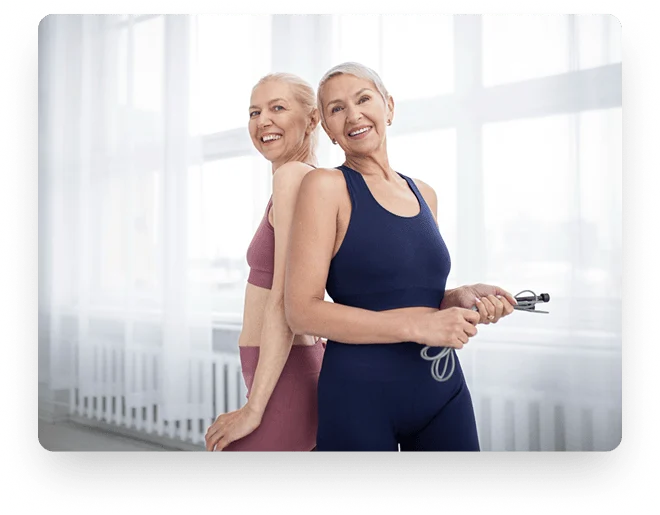
What women tell me in the first conversation:
- “I’m eating the same and doing the same workouts, and I’ve put on ten pounds — all of it in my stomach.”
- “I wake up at 3 AM and can’t get back to sleep. I’m exhausted all the time.”
- “My knees, hips and shoulders hurt in a way they never did. I stopped running because of it.”
- “I feel like I’m losing strength. Getting up off the floor is harder than it should be.”
- “I’ve done every diet. I’m scared of getting bulky.”
- “My doctor said to lift weights. Nobody showed me how.”
None of these are character flaws. They are the predictable results of a hormonal transition that changes how your body stores fat, keeps muscle, sleeps and recovers. Training built for that transition addresses every one of them.
What menopause does to your body (and why cardio and dieting stop working)
I’m a trainer, not a doctor, so I’ll stick to what the research shows and what I see in the studio every week. Your composition changes more than your weight. The largest long-term study of women through menopause (the SWAN study, more than 1,200 women) found that fat gain and muscle loss both accelerate during the menopause transition, independent of aging, while total body weight rises only gradually. The scale hides what is really happening: you are trading muscle for fat, and the fat is preferentially stored around the middle. Dieting harder makes it worse, because a calorie deficit without strength training takes muscle with it.
What the research shows:
- Body composition shifts even when weight doesn’t. Fat gain and lean-mass loss accelerate through the transition (SWAN cohort, JCI Insight 2019).
- Joints and muscles are genuinely affected. More than 70% of women report musculoskeletal symptoms; over half have joint pain. Researchers call it “the musculoskeletal syndrome of menopause” (Climacteric 2024).
- Heart-health risk accelerates. The American Heart Association calls the transition “a critical window” for early intervention (Circulation 2020).
- Sleep is disrupted by the transition itself. Trouble falling asleep, staying asleep and early waking all rise (SWAN, Sleep 2008); women who exercise consistently sleep better and deeper (SWAN Sleep Study 2013).
The good news inside those findings: every one of them responds to the same intervention. Progressive strength training rebuilds the muscle you are losing, protects bone, improves how your body handles blood sugar, eases joint pain through better loading rather than rest, and is one of the few things consistently linked to better sleep in midlife women.
One honest caveat. Exercise is not a treatment for hot flashes. The Menopause Society’s 2023 statement is clear that the evidence-backed options for hot flashes and night sweats are cognitive behavioral therapy, clinical hypnosis, certain prescription medications and, where appropriate, hormone therapy — and that exercise, yoga and supplements are not recommended for that purpose. One small trial did find that fitter women reported fewer, milder flashes, but I won’t sell you training as a hot-flash cure. Training is for everything else on this page. Bring your hot flashes to your clinician; bring your body to me.
How I train women through menopause
Strength first, two to three times a week. Progressive resistance training is the one intervention that directly reverses the composition shift. A 13-month trial in early-postmenopausal women found that well-designed higher-intensity training added lean mass, reduced total and abdominal fat, improved leg strength and power, and reduced menopausal symptoms compared with women who didn’t train. We start where your joints are today, not where a 30-year-old’s are, and we build load steadily. You will not get bulky. Women do not have the hormones for it, and the evidence is unambiguous.
Your program includes:
- Progressive strength training two to three times a week, programmed in 12-week blocks around your joints, schedule and recovery
- A realistic protein target, set by a certified nutritionist and spread across the day. No meal plans you’ll abandon by week three
- Mobility and joint care built in, including PNF assisted stretching, because training through pain is how women quit
- Sleep and recovery treated as training variables. No 5 AM workouts for a woman who isn’t sleeping
A plan that survives real life. Weekly check-ins, adjustments when travel, work or symptoms get in the way, and video form checks for online clients. What I don’t do: I don’t prescribe, diagnose or comment on your hormone therapy. I work alongside your doctor, and if you don’t have one who takes menopause seriously I’ll tell you what to ask for. Menopause-certified clinicians can be found through The Menopause Society’s practitioner directory.
What changes when the training is right
Results at this stage are measured in how clothes fit, what you can lift and how you sleep, not only on the scale. Twelve weeks in, this is what women typically report:
This includes:
- Waist measurement down while the scale barely moves, because the composition is changing
- Sleeping through the night more often, and waking with energy instead of dread
- Knees, hips and shoulders that hurt less, because they are stronger and moving better
- Getting up off the floor, lifting a suitcase into the overhead bin, carrying groceries in one trip
- Feeling at home in your body again, and confident it will carry you into your 60s and 70s
We track it: waist, strength on key lifts, sleep and energy. Measured, not guessed.
For women who are post-menopausal or worried about bone density
If you have been told you have osteopenia or osteoporosis, or you are simply past menopause and thinking about the next 30 years, strength training is the most protective thing you can do for bone. With medical clearance we program it safely:
- Appropriate loading through the hips and spine, progressed gradually, with no movements that put the spine at risk
- Balance and single-leg work, because a fall is what turns bone loss into a fracture
- Protein, calcium and vitamin D from food first, coordinated with whatever your physician has prescribed
- Coordination with your doctor or physical therapist when there is a diagnosis or a history of fracture
Menopause is a transition, not a verdict. The women I train in their 60s are often stronger than they were at 45, because for the first time someone trained them for the body they actually have.
Why me
I’m Jennifer Winestorfer: 48, a mother of two, and a woman going through this myself. I’ve been coaching for more than 15 years and have worked with over 500 women, most of them between 40 and 65. I’m an ISSA Master Trainer, a Certified Nutritionist and Health Coach. Before that I was a competitive gymnast, a five-time Ironman finisher including the World Championship in Kona, and an NPC Masters competitor at 46 — so I know what a body is capable of at this age when it’s trained properly, and I know what it feels like when it stops cooperating. Read my story.
Your coaching includes:
- A free 15-minute discovery call: what has changed, how you move, where to start
- A written 12-week program with progressions, revised as your body responds
- Weekly check-ins and adjustments for travel, work and symptoms
- Nutrition targets you can actually hit, from a certified nutritionist
- Coordination with your physician, menopause specialist or physical therapist when you want it
Every session is designed for the body you have this year, not the one you had at 30 or the one a generic program assumes.
In studio, in your home, or online
The program is the same wherever we train. What changes is how it fits your week.
This includes:
- Newport Beach studio — 120 Newport Center Drive #7002. Private sessions, by appointment
- Irvine studio — near John Wayne Airport. Private sessions, by appointment
- In-home across Orange County — Newport Beach, Corona del Mar, Costa Mesa, Irvine, Huntington Beach, Laguna Beach, Laguna Hills, Laguna Niguel, Laguna Woods, Aliso Viejo and Tustin. I bring the equipment
- Online, anywhere in the US — the same program through the JenCalling coaching app, with weekly video check-ins
Studio sessions from $99, in-home from $125, online coaching from $595. A free 15-minute discovery call always comes first, so neither of us commits before we know it’s a fit.
Where you can train
In studio in Newport Beach (120 Newport Center Drive) or Irvine (near John Wayne Airport). Private, by appointment, with full equipment for progressive strength work.
In your home anywhere in Orange County. I bring what we need. Many clients in perimenopause prefer this in the first block, when energy and confidence are lowest.
Online from anywhere in the United States, through the JenCalling coaching app with video form checks and weekly check-ins. See how online coaching works.
Whichever you choose, we start with a free 15-minute discovery call, in person or by video.
Read more
If you want the evidence and the practical detail behind this page, these are the places to start.
Related reading:
- Perimenopause Belly Fat: Why It’s Different and What Actually Works
- Why You’re Waking Up at 3 AM (and What Your Hormones Are Trying to Tell You)
- Why the Scale Is Lying to You
- How Much Protein Do Women Over 40 Actually Need?
- Creatine for Women Over 40: Does It Work, Is It Safe, and Should You Take It?
Let’s find out what’s actually going on
You are not imagining it, and you are not stuck.
Call or text (949) 432-6940, book a free 15-minute discovery call online, or send the form above. I reply within 24 hours.
This page provides general fitness and nutrition information and is not medical advice. Jennifer Winestorfer is a certified personal trainer and nutritionist, not a physician. Talk to your healthcare provider about menopause symptoms, hormone therapy and any medical condition before starting a new exercise program.
Frequently Asked Questions
Can a personal trainer help with menopause weight gain?
Yes, if the training is built for it. Menopause shifts your body toward more fat and less muscle even when your weight barely changes. Progressive strength training two to three times a week, with enough protein, rebuilds muscle and reduces abdominal fat; cardio and dieting alone tend to cost you more muscle. Results are measured in how clothes fit, strength and waist measurement, not only the scale.
What is the best exercise for perimenopause?
Resistance training is the foundation, because it addresses muscle loss, bone loss and blood-sugar handling at once. Add two or three brisk walks or short cardio sessions a week for heart health, and mobility work for joints. The best program is the one you can do consistently, which is why mine are built around your schedule and current fitness rather than a template.
Will lifting weights make me bulky?
No. Women’s hormones don’t support the muscle mass that “bulky” implies, and at midlife you are working hard just to hold on to the muscle you have. Lifting makes you firmer and stronger; it does not make you bigger.
Does exercise help hot flashes?
Not directly, and I’d rather tell you that than sell you something. The Menopause Society does not recommend exercise as a treatment for hot flashes; effective options are CBT, clinical hypnosis, certain medications and hormone therapy, which are conversations for your doctor. What training does do is improve sleep, mood, joint pain, strength, body composition and long-term heart and bone health.
I have joint pain. Can I still train?
Almost always, yes. Joint pain affects more than half of women around menopause and usually improves with the right loading, not rest. We start with what doesn’t hurt, use PNF stretching and mobility work, and progress carefully. If something needs a doctor or physical therapist first, I’ll say so.
Do I need to be on HRT for this to work?
No. Training works with or without hormone therapy. Whether HRT is right for you is a decision for you and your clinician; I’m happy to coordinate with them.
Do you work with women who are post-menopausal or have osteoporosis?
Yes. Strength training is the most protective thing you can do for bone at this stage, and with medical clearance we program it safely: appropriate loading, balance work, and no exercises that put the spine at risk.
How often should I strength train during menopause?
Two to three sessions a week is the sweet spot for most women: enough stimulus to rebuild muscle and bone, with enough recovery between sessions, which matters more now than it did at 30. Walking or light cardio on the other days is a bonus, not a requirement.
How much protein do I need?
More than most women eat. A practical target for active women over 40 is roughly 0.7 to 1 gram per pound of goal body weight per day, spread across three or four meals. We set your number in the first two weeks and work it into how you already eat.
Why am I waking up at 3 AM?
Sleep disruption is part of the menopause transition itself, tied to falling estrogen and night sweats, not just stress. Consistent exercise is one of the few things reliably linked to better sleep quality in midlife women. We also look at timing: hard sessions early enough to recover, and nothing that adds to the load on a bad week.
Can this be done online?
Yes. Online clients get the same 12-week program through the JenCalling coaching app, with video form checks and weekly check-ins. Many women start online and add studio or in-home sessions later, or the reverse.
What happens on the free discovery call?
Fifteen minutes by phone or video. We talk about what has changed, and you leave with a clear picture of what to do next, whether or not you decide to work with me.
Do you offer this in Irvine as well as Newport Beach?
Yes. There are studios in both Newport Beach (120 Newport Center Drive) and Irvine (near John Wayne Airport), plus in-home training across Orange County.
Is there a trainer in Orange County who specializes in menopause?
That is exactly what this page is. I am an ISSA Master Trainer and Certified Nutritionist who has spent 15 years training women 40 to 65, and I am going through this transition myself. Book a free 15-minute discovery call and see whether it’s a fit.
You don’t have to figure this out alone, and you don’t have to keep fighting your body with the tools that worked at 30. Book a free 15-minute discovery call and let’s see what is actually going on.
Serving women in perimenopause and menopause in Newport Beach, Corona del Mar, Costa Mesa, Irvine, Huntington Beach, Laguna Beach, Laguna Hills, Laguna Niguel, Laguna Woods, Aliso Viejo and Tustin, and online across the United States.