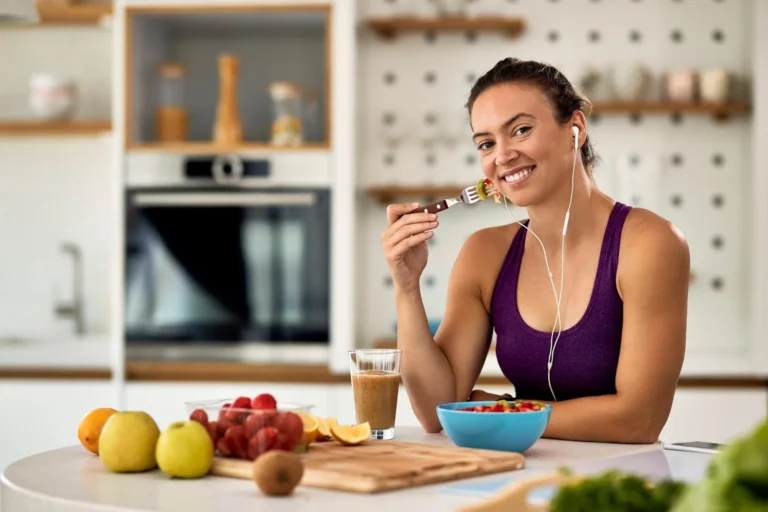

When the Tool Becomes the Problem, and How to Take Back Control
I need to say something that might surprise you coming from a trainer who talks about protein, carbs, and fats on a daily basis:
Tracking your macros should make your life easier, not harder.
If it’s making you anxious, if you’re afraid to eat a meal you didn’t log first, if the number on the app is deciding whether you feel good or terrible about yourself today, then the tool has stopped serving you. And we need to talk about that.
If it’s making you anxious, if you’re afraid to eat a meal you didn’t log first, if the number on the app is deciding whether you feel good or terrible about yourself today, then the tool has stopped serving you. And we need to talk about that.
That’s not health. That’s a cage with a calorie counter on the door.
Macro Tracking Is a Skill, Not a Lifestyle
Here’s what I believe, and what I’ve seen work with hundreds of women between 35 and 65:
Macro tracking is a learning tool. It teaches you what’s in your food, how much protein you’re actually getting (usually less than you think), and what a balanced plate looks like in real terms. That awareness is valuable. It can be the difference between guessing and knowing.
The International Society of Sports Nutrition recommends that active individuals consume between 1.4 and 2.0 grams of protein per kilogram of body weight per day. Most women I work with are nowhere near that range when we first start, and they only discover that gap through tracking. If you’re wondering what the right target looks like for you specifically, I break down the numbers in how much protein women over 40 actually need.
So tracking has a purpose. But the purpose is education, not imprisonment.
The goal is to learn enough about your food that you can eventually make confident choices without needing an app to tell you it’s okay to eat.
When Tracking Crosses a Line
Research from Duke University’s Department of Psychiatry has raised important concerns about the relationship between food tracking apps and disordered eating behaviors. Their work highlights that apps which quantify everything (calories, macros, weight, streaks) can trigger obsessive thinking, rigid dieting patterns, and an unhealthy dependence on external validation from numbers.
A peer-reviewed study published through the National Institutes of Health found that roughly 73 percent of individuals with eating disorders who used calorie tracking apps perceived those apps as contributing to their symptoms. That number stopped me when I first read it. Seventy-three percent.
Now, this doesn’t mean tracking causes eating disorders. The research is clear that the relationship is complex and likely bidirectional. But it does mean that for some women, particularly those with a history of restrictive dieting, perfectionism, or anxiety around food, tracking can reinforce the very patterns that hold them back.
If any of this sounds like you, please hear me: you are not broken. Your brain is doing exactly what it was trained to do by a culture that rewards control and punishes appetite. Unlearning that is not weakness. It’s courage.
A Better Way to Use Macros
So how do you get the benefits of macro awareness without the mental spiral? Here’s what I coach my clients through, and what I practice myself.
Track to learn, then step back. I recommend tracking consistently for two to four weeks when you’re first starting out or resetting your nutrition. Use that time to learn your patterns, identify gaps, and understand portion sizes. Then put the app down and practice what you’ve learned with your eyes, your hands, and your hunger cues. Come back to tracking for a tune-up week if things feel off, but don’t live there.
Use your hand as a guide. A palm-sized portion of protein. A cupped hand of carbs. A thumb-sized portion of fat. A fist of vegetables. This is not exact science, and that’s the point. Your body does not need you to be exact. It needs you to be consistent and present.
Stop calling food good or bad. The second you label a food as “bad,” you’ve introduced guilt into something that should nourish you. A cookie is not a moral failure. An extra serving of rice is not a disaster. The language you use around food becomes the relationship you have with it. Choose words that build trust, not shame.
Eat enough. This is the one that needs to be said louder. So many women I work with are under-eating and wondering why they feel terrible, why they can’t build muscle, why their hormones are off, why their hair is thinning. Tracking macros should reveal that you need more, not give you permission to eat less. If you’re strength training and feel like your body isn’t responding, the answer is almost always more fuel, not less. I talk about this in depth in building muscle after 40 and 50.
Think beyond the macros. Once you’ve built awareness around protein, carbs, and fats, the next level is paying attention to the vitamins and minerals that actually determine how your body feels. You can hit your macro targets and still be deficient in the nutrients that drive your energy, recovery, and hormone balance.I wrote about this in everyone talks about macros, but what about the micros?
What Mindful Eating Actually Looks Like
The Harvard T.H. Chan School of Public Health describes mindful eating as being fully attentive to your food, noticing colors, textures, flavors, and your own hunger and fullness signals, without judgment. Research from their department has shown that mindful eating can reduce emotional overeating and improve satisfaction with meals.
I love this concept because it moves the conversation from how much to how it feels. Instead of asking “did I hit my macros?” you start asking “am I nourished? Am I satisfied? Did I eat in a way that supports how I want to feel this afternoon?”
That shift, from external tracking to internal awareness, is where the real transformation happens. Not on the scale. Not in the app. Inside you.
What This Looks Like in Practice
A day of eating well without obsessing might look like this:
Morning: Two eggs scrambled with spinach and a slice of Ezekiel toast. Coffee with a splash of cream. No weighing. No logging. Just a plate you’ve learned to build with confidence.
Midday: Grilled salmon over mixed greens with avocado, cherry tomatoes, and a drizzle of olive oil. You know this hits your protein and healthy fats because you’ve practiced this plate dozens of times.
Midday: Grilled salmon over mixed greens with avocado, cherry tomatoes, and a drizzle of olive oil. You know this hits your protein and healthy fats because you’ve practiced this plate dozens of times.
Dinner: Ground turkey stir-fry with bell peppers, zucchini, and brown rice. Enough to feel full, not stuffed. Enjoyed at the table, not standing over the counter scrolling your phone.
That’s it. No drama. No guilt. No app notification telling you that you’re 47 calories over your limit. Just food that supports the work your body does and the life you want to live. And if you want more specific ideas for how to structure meals around your training, I lay out real plates and timing strategies in what to eat before and after a strength training session.
Frequently Asked Questions
How long should I track my macros?
Track consistently for two to four weeks when you are first starting out or resetting your nutrition. Use that time to learn your patterns and identify gaps, then step back. The purpose is education, not a permanent way of living.
How much protein should I actually be eating?
The International Society of Sports Nutrition recommends that active individuals consume between 1.4 and 2.0 grams of protein per kilogram of body weight per day. Most women are nowhere near that.
How do I estimate portions without an app?
Use your hand. A palm-sized portion of protein, a cupped hand of carbohydrates, a thumb-sized portion of fat, and a fist of vegetables. It is not exact science, and that is the point.
Can macro tracking become unhealthy?
It can for some people. Research from Duke University has raised concerns about the relationship between food tracking apps and disordered eating, and a study published through the National Institutes of Health found roughly 73 percent of individuals with eating disorders who used calorie tracking apps perceived those apps as contributing. The relationship is complex and likely bidirectional, so tracking does not cause eating disorders, but it is worth watching how it makes you feel.
What does mindful eating actually mean?
The Harvard T.H. Chan School of Public Health describes mindful eating as being fully attentive to your food, noticing colours, textures and flavours as well as your own hunger and fullness signals, without judgement.
The Bigger Truth
You did not start exercising so that food could become your enemy. You started because you wanted to feel strong, capable, alive. Nutrition is supposed to support that feeling, not steal it.
If macro tracking helps you get there, use it wisely and put it down when it no longer serves you. If it’s become a source of stress, give yourself permission to step away. You will not lose everything you’ve built. You will not suddenly forget how to eat well. Your body already knows. You just have to trust it.
Awareness without anxiety. Knowledge without control. Nourishment without punishment.
That’s the goal. And you are fully capable of getting there.
If you’re looking for guidance that is supportive, structured, and rooted in real-life application, you can explore my nutrition coaching services or reach out to connect with me here.
An Affirmation for You:
I do not need an app to tell me I am doing enough. I trust my body’s signals. Food is not a test I pass or fail. It is a gift I receive with gratitude and intention.
Love Yourself,
Jennifer Winestorfer💖