
She Holds Everything Together. Except How She Feels About Herself.
I know a woman. You probably know her too.
She’s the one who never misses a deadline. The one who remembers everyone’s birthday. The one who manages the house, the career, the kids, the appointments, the groceries, the emotional needs of every person in her orbit. She’s the one people call when they don’t know what to do.
She is, by every external measure, strong.
And she doesn’t feel it. Not even close.
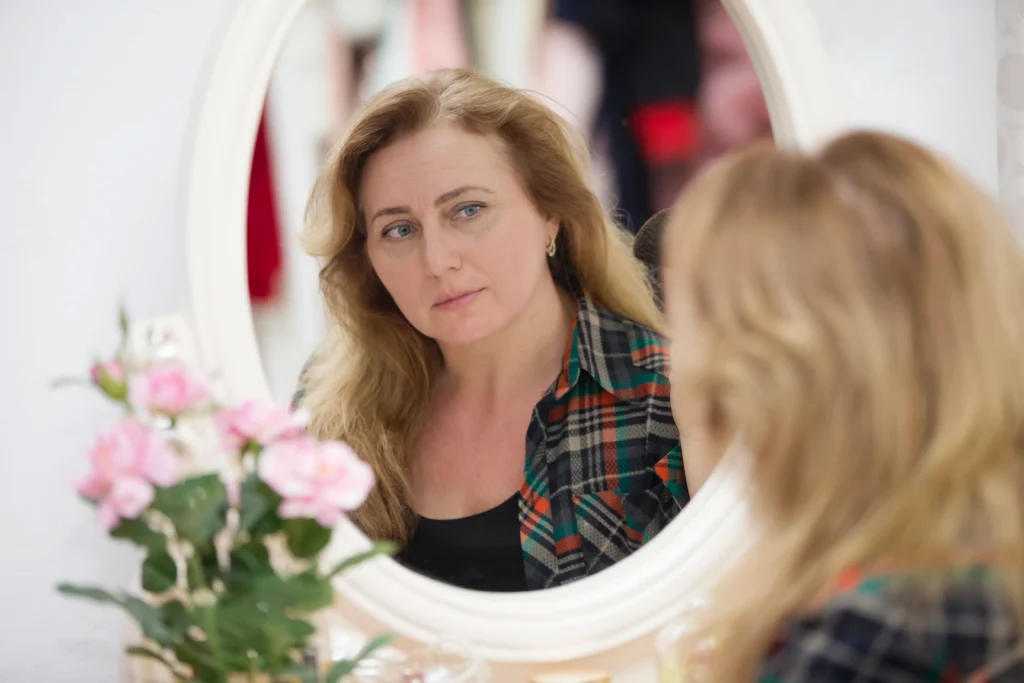
When she looks in the mirror, she doesn’t see the woman everyone else sees. She sees the soft spots. The lines. The parts that don’t match the version of herself she carries in her head, the one from ten or fifteen years ago that she’s quietly mourning without realizing it.
She feels like a fraud. Like the gap between how she appears and how she actually feels inside is growing wider every year. And she can’t talk about it because she’s supposed to be the strong one. The one who has it together. The one who doesn’t need help.
I know this woman because I’ve been her. And because she walks into my practice every single week wearing a different face.
The Gap Nobody Talks About
There’s a disconnect that happens to women, especially between 35 and 65, that nobody in the fitness industry addresses honestly. It’s the gap between competence and confidence. Between what you can do and how you feel about who you are.
You can run a company and still feel uncomfortable in a swimsuit. You can deadlift your body weight and still avoid mirrors. You can meal prep for the week, crush your workouts, show up for everyone in your life, and still lie in bed at night feeling like you’re not enough.
A 2023 study published in Frontiers in Psychology studied 1,214 women across four age groups, from ages 18 through 75. The researchers found that body image disturbance changes with age rather than simply disappearing: body objectification and trait body dissatisfaction decreased from younger to older adulthood, while state body dissatisfaction increased.
In other words: the culture that taught you at 14 to judge your body by how it looks hasn’t released its grip just because you turned 45. It just got quieter. More subtle. More internalized.
And now, layered on top of that, you have perimenopause changing your body in ways you didn’t expect, a culture that worships youth, and an inner voice that compares everything you are now to everything you used to be.
That’s the confidence gap. And it has nothing to do with how strong you actually are.
Where This Really Comes From
I could tell you this is about social media and unrealistic beauty standards, and that’s partly true. But for most of the women I work with, the roots go deeper than Instagram.
It starts with how we learned to relate to our bodies in the first place.
I learned to see my body as a project when I was six years old on a gymnastics mat. My body was something to be evaluated, scored, judged. And the more I controlled it, the more approval I received. That belief followed me into adulthood and nearly destroyed me.
Most women I coach didn’t grow up as competitive gymnasts, but they have their own version of that story. Maybe it was a comment from a parent. A number on a scale at the doctor’s office that suddenly became the most important thing in the room. A dress size that became their identity. A boyfriend who made them feel like they needed to be smaller, quieter, less.
Those experiences don’t always disappear with time. They can become deeply ingrained. And decades later, a woman who is objectively accomplished, strong, and capable can still be running the program she learned at twelve: my worth is tied to how my body looks.
The confidence gap isn’t about needing more achievements. It’s about needing to rewrite the story underneath all of them.
Why Achievement Doesn’t Fix It
This is the part that confuses so many women, and it confused me for years.
I thought if I trained harder, I’d feel better about my body. I thought if I competed and placed, I’d finally feel confident. I thought if I got lean enough, toned enough, disciplined enough, the gap would close.
It didn’t.
I stood on the NPC stage in the best shape of my life, and the gap was still there. In fact, it was wider than ever, because now I had a body that the world praised but that I couldn’t maintain without behaviors that were quietly destroying me.
Achievement doesn’t close the confidence gap because the gap isn’t about what your body can do. It’s about how you relate to the woman living inside it.
You can’t out-train a belief system. You can’t out-diet a belief about your worth. You can’t out-perform a story you’ve been telling yourself for thirty years.
You have to change the story.
A 2025 study, Female Body Perception: Social Norms, Criticism, and the Impact of Weight Perception, published in the International Journal of Qualitative Studies on Health and Well-being, explored how social norms, criticism, and weight perception shape women’s body image. The researchers found that body image is influenced by physical characteristics, societal pressures, and emotional experiences, and that social evaluation, criticism from others, and pressure to look “perfect” can undermine self-confidence and increase appearance-related anxiety.
The authors also point to prior research that offers something hopeful: participation in sports and exercise programs has been associated with improved physical self-perceptions and reduced body-related social anxiety, while regular exercise has also been linked to psychological resilience and increased self-confidence.
Not because exercise changes how you look. But because it changes how you experience your body.
That’s the difference between training to punish your body and training to reconnect with it.
What Closing the Gap Actually Looks Like
The women I’ve watched close this gap didn’t do it by reaching a goal weight. They didn’t do it by buying new clothes or getting a compliment from a stranger. They did it by changing their relationship with their own body, slowly, imperfectly, and honestly.
Here’s what that process looks like in real life:
It starts with noticing the voice. Every woman has one. The voice that says “not lean enough,” “not toned enough,” “not young enough.” You can’t change what you don’t notice. Start paying attention to when that voice speaks, what triggers it, and whose voice it really is. Because sometimes that voice isn’t entirely your own. It may echo messages you absorbed from other people a long time ago.
It moves into doing things your body can do, not just judging how it looks. The first time a client of mine lifts a weight she didn’t think she could, something shifts in her eyes. Not because her body changed in that moment, but because her perception of herself did. She went from “I’m not strong enough” to “I just did that.” And that experience, repeated over weeks and months, starts rewriting the story.
It requires letting go of the body you used to have as your standard. This one is hard, and nobody wants to talk about it. The body you had at 30 belonged to a different season of your life. She served you. She carried you. But measuring the woman you are today against the woman you were then can keep you from appreciating the body you have now. Letting go of that comparison, with gratitude and without resentment, can be incredibly freeing.
It demands separating your worth from your appearance. You are not your body fat percentage. You are not your jean size. You are not the number on the scale. You are a woman with decades of experience, strength that doesn’t show in a mirror, and a value that has absolutely nothing to do with how you look in a photo.
It often requires professional support. A therapist who understands body image. A wellness team that sees you as a whole person. A trainer who cares more about how you feel than how you look. You don’t have to close this gap alone. For many women, having the right support can make it easier to understand where these beliefs came from and begin changing them.
What I Want You to Know
If you are a woman who looks strong on the outside and feels fragile on the inside, I see you. Not because I’m watching from a distance, but because I’ve been exactly where you are.
I’ve stood in front of a mirror in competition shape and felt empty. I’ve received compliments that made me feel worse instead of better. I’ve achieved every physical goal I set for myself and still gone to bed wondering if I was enough.
The gap doesn’t close through more effort. It closes through honesty. Through the terrifying, liberating decision to stop performing strength and start actually building it. Not in your muscles. In your relationship with yourself.
That’s the work I do with women every day. Not just helping them build stronger bodies, but helping them rebuild the connection between who they are and who they see in the mirror. Because until those two women recognize each other, no workout in the world will be enough.
You are not your reflection. You are not your worst thought about yourself. You are not the 14-year-old girl who learned that her body was a problem to solve.
You are a woman who has survived, achieved, endured, and carried more than most people will ever know. And the fact that you still don’t feel strong? That’s not proof that you’re weak. That’s proof that the world taught you to measure strength by the wrong things.
It’s time to learn a new measurement.
Frequently Asked Questions
Why do I still feel insecure about my body even though I work out regularly?
Because body confidence isn’t built in the gym alone. It’s shaped by decades of messaging, cultural conditioning, and personal experiences that taught you to evaluate yourself from the outside. Exercise can absolutely help by changing how you experience your body, but lasting confidence also requires addressing the beliefs underneath the insecurity. That often means working with a therapist, building community, and consciously rewriting the story you’ve been telling yourself about your worth.
Is body image something that improves with age?
The research is mixed. Some studies show that body dissatisfaction decreases as women get older, while others show it persists well into the 60s and 70s. What I’ve seen in my coaching practice is that it doesn’t improve automatically with age. It improves with intention. Women who actively work on their relationship with their body, through movement, support, and honest self-reflection, experience a shift that women who just wait for it to get better often don’t.
An Affirmation for You:
I am more than what the mirror reflects. My strength is not measured by how I look but by how I show up. I release the version of myself I was taught to chase and embrace the woman I actually am.
If you’re ready to close the gap between how the world sees you and how you feel inside, you can explore my personal training and coaching services or reach out to connect with me here.
Love Yourself,
Jennifer 💖