
Sports Conditioning for Women in Newport Beach, Orange County & Online
Train with purpose, move like an athlete, and perform at your best
Performance-based training for women ages 35–65 designed to improve strength, speed, coordination, and overall athletic ability, whether you are local or working with me remotely.
Book a free 15-minute movement & performance discovery call
In studio in Newport Beach or Irvine, in your home anywhere in Orange County, or online. We look at how you move, where the limits are, and how to train for your sport. No pressure, no commitment.
- Google Guaranteed
- ISSA Master Trainer & Certified Nutritionist
- Women 35–65 training for sport and events
- 15+ years, 500+ client transformations
Related reading:
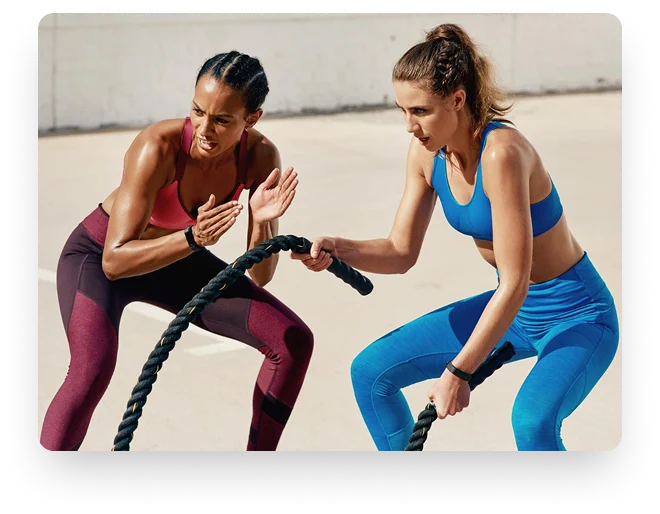
This is not just cardio. This is how your body learns to perform
You might be wondering
- Do I need this if I am not an athlete?
- Will this help me get stronger or just more tired?
- How is this different from strength training or cardio?
- Can this help prevent injuries?
- Will this improve my performance in other workouts?
What sports conditioning actually does
Sports conditioning trains your body to move with control, power, and efficiency. This includes speed and acceleration work, agility and change-of-direction drills, balance and coordination training, core stability, and explosive strength development. It improves how your muscles work together, not just individually.
Why this matters for your body
As we age, we naturally lose power, coordination, and reaction time. These are essential qualities that support movement capacity, confident performance, and long-term independence.
Sports conditioning helps preserve and improve these abilities so your body stays strong, capable, and responsive.
How this supports your overall training
When combined with strength training and cardio, sports conditioning creates a complete and balanced program. It is designed to enhance movement quality, improve efficiency, and build training tolerance while supporting better performance in both workouts and daily life.
Proper nutrition also plays a key role in how your body recovers, performs, and adapts to training, especially when incorporating higher-intensity or performance-based work.
Who this is for
- Women who want to feel more athletic and capable
- Clients looking to improve coordination and balance
- Women returning to fitness after time off
- Athletes training for performance or specific events
- Anyone who wants to move better and feel stronger in everyday life
What your training may include
- Sprint drills and acceleration work
- Agility ladders and cone drills
- Plyometric exercises for power
- Medicine ball training
- Functional movement patterns
- Reaction and coordination drills
Where you can train
Sports conditioning can be performed in a variety of environments depending on your goals and preferences.
- At home
- Outdoors in parks or open spaces
- At a gym or training facility
- In a sport-specific environment
Your program is designed to be flexible, effective, and aligned with your lifestyle.
Clients in Newport Beach benefit from more consistent scheduling for performance-focused training and progression.
A complete approach to lasting results
Sports conditioning is one piece of a complete program. To support your full transformation, combine it with structured strength training, strategic cardio, and personalized nutrition coaching to support performance, recovery, and long-term results
Move better, feel stronger, and stay capable
This is not about training like an athlete. It is about giving your body the tools to move, react, and perform at its best.
Frequently Asked Questions
What is sports conditioning, and how is it different from regular strength training or cardio?
Strength training primarily develops force and muscle; cardio develops aerobic or anaerobic endurance. Sports conditioning connects those qualities to movement demands such as acceleration, deceleration, power, agility, coordination, balance, and repeated efforts. A good program still uses strength and cardio, but it organizes them around what you want your body to do. That might mean preparing for a race, moving faster on a court, improving power for golf, or simply feeling more athletic.
Do I need sports conditioning if I am not a competitive athlete?
No competition is required. Sports-conditioning methods can be useful for recreational athletes and active adults who want better coordination, power, balance, and confidence when they move. The drills should be scaled to your current ability rather than copied from elite athletes. If your goal is simply general health, basic strength and cardio may be enough; conditioning becomes valuable when you have a performance, activity, or movement goal that benefits from more specific training.
I’m over 40 and want to train for my first 5K. Where should I start?
Start with your current ability, not the race distance. A beginner plan usually builds a consistent walking and running base gradually, while strength work supports the tissues that have to tolerate repeated impact. The weekly increase should be conservative enough that soreness and fatigue settle between sessions. Jennifer can build a run/walk progression around your schedule and history instead of assuming you should already be able to run continuously.
Can I train for my first triathlon in my 40s or 50s?
Yes, many adults begin endurance sports in midlife. The key is choosing a realistic event, building swim-bike-run volume gradually, and leaving enough room for strength, technique, recovery, and fueling. Your starting fitness, swimming comfort, bike skills, injury history, and available training time all matter. Jennifer is a five-time Ironman finisher, including the Ironman World Championship in Kona, so she can translate that endurance experience into a plan built for your level.
How do I improve speed, power, and agility without getting hurt?
Earn the right to go fast by building the basics first. Good acceleration and agility work starts with strength, landing and deceleration control, balance, and technique at lower speeds. From there, intensity can increase gradually. The goal is quality repetitions, not exhaustion. If you have a current injury or significant pain, resolve the appropriate medical or rehabilitation questions first before adding explosive drills.
I’m returning to running or sports after years off. How do I rebuild safely?
Treat yourself like a beginner with experience, not like the athlete you remember being. Your cardiovascular fitness may return faster than your tendons, joints, and tissues adapt to impact and speed, so volume and intensity should increase gradually. Rebuild strength, movement control, and an aerobic base before stacking hard sessions. A structured return plan also gives you objective checkpoints so enthusiasm does not outrun tissue tolerance.
How much strength training should an endurance athlete do?
Most endurance athletes benefit from keeping regular strength work in the program, often two focused sessions per week during many phases of training. The exact volume changes with race distance, training age, and where you are in the season. The goal is enough strength stimulus to support force production and durability without creating so much soreness that it compromises key endurance sessions. Exercise selection and timing matter more than chasing a bodybuilding-style workload.
How do I balance endurance training, strength training, and recovery?
Decide which sessions are truly hard and avoid turning every day into a competition. Easy aerobic work should stay easy enough to support recovery, key endurance sessions need space, and strength training should be placed where it does not repeatedly sabotage your highest-priority workouts. Sleep, fueling, and planned lighter weeks matter too. Jennifer builds the week as one integrated system so each session has a purpose.
Can sports conditioning help with tennis, golf, pickleball, or other recreational sports?
Yes, when the program reflects the demands of the activity. Court sports may benefit from lateral movement, deceleration, rotational control, and repeated short bursts. Golf may place more emphasis on rotational strength, balance, hip and thoracic mobility, and force transfer. The point is not to mimic the sport with random drills; it is to develop physical qualities that help you move and perform more effectively when you actually play.
Does it matter if my coach has actually trained for endurance events?
First-hand experience is not a substitute for sound coaching, but it can add useful context when combined with education and individualized programming. A coach who has trained through long build cycles understands the practical realities of pacing, fatigue, fueling, setbacks, race-day nerves, and balancing training with life. Jennifer combines coaching credentials with personal experience across marathons, triathlons, five full Ironmans, and the Ironman World Championship.
How do I train for a 10K or half marathon in my 50s?
Build distance gradually, keep most of your running easy enough to hold a conversation, and keep strength training in the plan rather than dropping it once mileage climbs. Masters runners generally need more recovery between hard sessions than a plan written for a younger athlete assumes. Twelve to sixteen weeks is a reasonable block for a 10K from an existing base; a half marathon usually wants longer. Jennifer builds the progression backward from your race date and current running volume.
How should a masters athlete train differently?
Recovery tends to become the limiting factor rather than effort. That usually means fewer genuinely hard sessions with more space between them, more attention to sleep and protein, a real warm-up, and strength training kept in the program year-round to offset age-related muscle loss. Many masters athletes are not undertrained so much as under-recovered. Jennifer competes as a masters physique athlete and has raced long-course triathlon, so the programming reflects that reality rather than a template built for a twenty-five-year-old.
What is involved in training for a first half Ironman or Ironman?
A long runway and a gradual build. A half-distance event generally wants several months from a reasonable base, and a full distance considerably longer. Most training volume should stay easy, with a limited number of genuinely hard sessions, and swim technique often needs the most attention for newer triathletes. Fueling and pacing shape race day at least as much as fitness does. Jennifer has completed five Ironman events including the Ironman World Championship in Kona and coaches both the training and the fueling side.
Can someone in Orange County coach me for my first 5K, triathlon, or endurance goal after 40?
Yes. Jennifer Winestorfer provides sports-conditioning, running, and triathlon coaching through JenCalling for women in Newport Beach and throughout Orange County, with online coaching available nationwide. Your plan can combine event-specific endurance work, strength, mobility, recovery, and nutrition guidance so the program fits your starting point and the actual demands of the event rather than using a generic race template.
You don’t need a perfect diet. You need a plan that works for your life.
Serving women in Newport Beach, Costa Mesa, Corona del Mar, Irvine, Huntington Beach, Laguna Beach, Tustin, Aliso Viejo, Laguna Niguel, Laguna Hills, and Laguna Woods.